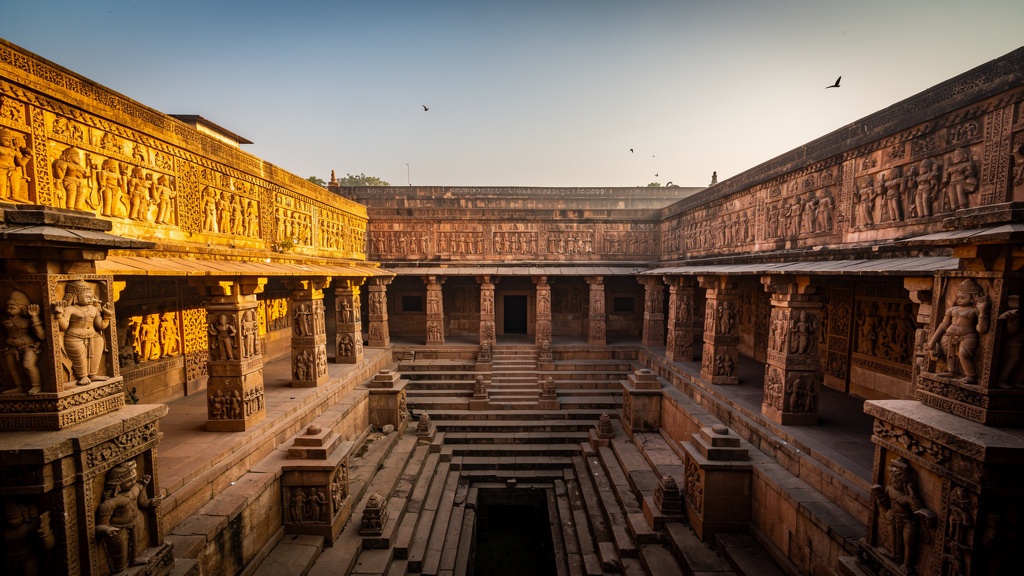
The magnificent Modhera Sun Temple at golden hour, Mahesana, Gujarat
North Gujarat, India

Welcome to Mahesana — Where History Meets Hospitality

Explore one of Gujarat's most historically rich and culturally vibrant destinations. From the thousand-year-old Modhera Sun Temple and UNESCO-listed stepwells to joyful Navratri nights and India's most cherished vegetarian cuisine, Mahesana is a journey that stays with you forever.

1000+ Years of History
3 UNESCO Sites Nearby
9 Nights of Navratri
50+ Historic Landmarks
Discover Mahesana

The Cultural Heartland of North Gujarat

Nestled in the fertile plains of North Gujarat, Mahesana (also known as Mehsana) stands as one of the most historically significant and culturally vibrant cities of western India.

Panoramic view of Mahesana city, Gujarat at sunset
About Mahesana

A City Where Ancient Stones Whisper Stories

Mahesana district, covering an area of approximately 4,386 square kilometres and home to over 2.5 million people, occupies a special place in the story of Gujarat. The city itself lies about 75 kilometres north of Ahmedabad, making it easily accessible from Gujarat's commercial capital, and yet it feels a world apart — steeped in the unhurried grace of a place that has seen kingdoms rise and fall over millennia.

The name Mahesana is derived from "Mahesh" (another name for Lord Shiva) and "sthana" (place), translating roughly to "the abode of Mahesh." This etymology tells you something important about the city's soul: it is, at its core, a place of devotion, of ancient ritual, of stone and spirit intertwined. Temples are not merely tourist sites here — they are living centres of daily worship, throbbing with incense smoke, the ring of brass bells, and the murmur of Sanskrit verses.

Yet Mahesana is no mere museum piece. It is a thriving commercial hub, famous across India for its dairy industry — home to the legendary Dudhsagar Dairy, one of Asia's largest milk-processing plants — and for its agricultural richness. The surrounding countryside ripples with mustard fields and cotton farms, and the roads hum with the activity of a district that feeds not just its own population but a significant portion of Gujarat's dairy needs as well.

  • District headquarters of Mahesana district, North Gujarat
  • Gateway to the Modhera Sun Temple & Rani ki Vav UNESCO site
  • Home to Asia's largest dairy co-operative processing facility
  • One of India's most exuberant Navratri celebrations
  • World-class Gujarati vegetarian cuisine heritage
Why Visit

Seven Reasons to Choose Mahesana for Your Next Journey

Beyond the temple photographs and tourist brochures, Mahesana offers layers of authentic experience that few Indian destinations can match.

Ancient Architecture

Marvel at 1,000-year-old stone carvings at the Modhera Sun Temple — India's finest example of Solanki-era craftsmanship.

UNESCO Heritage

Stand at the edge of Rani ki Vav, the world's finest stepwell and a UNESCO World Heritage Site, just 40 km from Mahesana.

Navratri Nights

Experience the nine electrifying nights of Navratri — India's biggest dance festival — celebrated with unmatched passion in North Gujarat.

Gujarati Cuisine

Savour the legendary Gujarati thali — a symphony of flavours balancing sweet, spicy, and tangy across a dozen small bowls.

Rural Heartland

Explore the surrounding villages, dairy farms, and mustard fields that paint the countryside in vivid seasonal colours.

Warm Hospitality

Discover Gujarati warmth firsthand — a culture that treats every guest as a gift, making first-time visitors feel like family.

Affordable Travel

Enjoy India's rich cultural tapestry without the tourist surcharges — Mahesana remains beautifully off the beaten path.

Central Location

Use Mahesana as your base to explore Patan, Siddhpur, Vadnagar, and Modhera — all within an easy day's drive.

Crown Jewel

The Modhera Sun Temple — India's Greatest Solar Shrine

Of all the wonders that await the traveller in and around Mahesana, nothing compares to the Modhera Sun Temple. Built around 1026 CE by the Solanki king Bhimdev I, this architectural masterpiece stands as a testament to the extraordinary achievements of medieval Gujarat at the height of its golden age. Located approximately 25 kilometres southwest of Mahesana city in the small village of Modhera, the temple is dedicated to Surya — the sun god — and was designed with breathtaking astronomical precision.

The temple complex unfolds across three distinct, harmoniously connected sections: the Sabha Mandapa (assembly hall), the Gudhamandapa (vestibule), and the Garbhagriha (inner sanctum). But it is the enormous Kund — a step-tank or vav — that first commands the visitor's attention, its perfectly proportioned steps descending in terraces adorned with 108 miniature shrines dedicated to the Solanki pantheon. When the winter sun strikes the tank's surface at dawn, the water blazes like molten gold and the shrine niches glow in warm amber light — a spectacle that has stunned visitors for a thousand years and continues to do so today.

📌 Visitor Information — Modhera Sun Temple

Location: Village Modhera, ~25 km from Mahesana city  |  Timings: Sunrise to Sunset, all days  |  Entry Fee: ₹25 Indians, ₹300 Foreign nationals  |  Best Time: October to March, especially at sunrise

The Modhera Sun Temple is not merely a monument — it is a solar calendar, a celestial clock, and a hymn in stone to the power of human ingenuity and devotion, all rolled into one breathtaking whole.

— Archaeological Survey of India

Every year in January, the Archaeological Survey of India and the Gujarat Tourism Department organise the spectacular Modhera Dance Festival (Uttarardh Mahotsav) on the temple grounds. Against the backdrop of the floodlit Sun Temple, classical dancers from across India perform Bharatanatyam, Odissi, Manipuri, and Kathak in honour of the same Surya deity the temple has worshipped for a millennium. This three-day festival is perhaps the most sublime confluence of ancient architecture and living art form anywhere in South Asia, and attendance is absolutely essential for any visitor serious about experiencing the depth of Mahesana's cultural heritage.

Top Destinations

Must-Visit Places in & Around Mahesana

From ancient temples to vibrant bazaars, each site tells a unique chapter of North Gujarat's extraordinary story.

Modhera Sun Temple reflected in the sacred kund stepwell
Heritage Temple

Modhera Sun Temple

A 1,000-year-old Solanki masterpiece of stone carving, astronomical precision, and divine beauty. India's finest sun temple and one of the subcontinent's greatest architectural achievements.

Explore Modhera
The ornate multi-tiered Rani ki Vav stepwell, Patan
UNESCO Heritage

Rani ki Vav, Patan

The world's most ornate stepwell, inscribed on the UNESCO World Heritage List. Just 40 km from Mahesana, this 11th-century wonder features 800+ intricately carved sculptures across its seven levels.

Explore Rani ki Vav
Women in traditional Gujarati chaniya choli performing Garba during Navratri
Cultural Festival

Navratri Celebrations

Nine electrifying nights of Garba and Dandiya Raas, celebrated with unmatched fervour across Mahesana district. Traditional chaniya choli, live folk music, and the scent of incense fill the air.

Discover Culture
View All Attractions →
Deep History

A City Forged Through the Ages — The Story of Mahesana

Few cities in Gujarat carry as layered and rich a historical legacy as Mahesana. Its roots extend deep into antiquity — the surrounding district was already settled and culturally sophisticated thousands of years before the Common Era. Archaeological evidence from sites scattered across the district indicates human habitation going back to the Chalcolithic and Bronze Age periods, potentially even overlapping with the fringes of the great Indus Valley Civilisation that flourished in this region of the Indian subcontinent between roughly 3300 BCE and 1300 BCE.

By the early centuries of the Common Era, the region was already an established node on the trade and pilgrimage routes connecting the ports of the Saurashtra peninsula with the plains of Rajputana and the Gangetic heartland. The Solanki (or Chaulukya) dynasty, which rose to power in Gujarat in the late 10th century CE, would transform Mahesana and its surroundings into a showcase of artistic and architectural ambition that has never been surpassed in the region. Under rulers such as Mularaja I (940–995 CE), Bhimdev I (1022–1064 CE), and the great Kumarpal (1143–1172 CE), the Solanki empire patronised an extraordinary flowering of temple architecture that produced, among other masterpieces, the Modhera Sun Temple, the temples of Vadnagar, and the Rudra Mahalaya complex at Siddhpur — all within the modern boundaries of Mahesana district.

c. 1026 CE — The Modhera Sun Temple

Solanki king Bhimdev I commissions the Sun Temple complex at Modhera, establishing the district as a centre of Solanki artistic achievement.

c. 1063 CE — Rani ki Vav, Patan

Queen Udayamati constructs the magnificent stepwell at Patan in memory of her husband Bhimdev I, creating what UNESCO would later call the finest stepwell in the world.

1297 CE — Alauddin Khalji's Invasion

The Delhi Sultanate forces march through Gujarat, sacking Patan and causing severe damage to many Solanki-era monuments in the region.

16th–18th Century — Mughal Period

Mahesana district passes through successive periods of Mughal and Maratha influence, with trade routes and local culture adapting to new political realities while retaining deep Hindu devotional roots.

1803–1947 — British Raj

Mahesana becomes part of the Bombay Presidency. The arrival of the Western Railway line in the late 19th century transforms the city into a significant commercial junction.

1960 — Formation of Gujarat State

With the bifurcation of Bombay State on linguistic lines, Mahesana becomes part of the newly formed Gujarat state, growing rapidly as an industrial and dairy hub.

2014 — UNESCO World Heritage

Rani ki Vav at nearby Patan is inscribed as a UNESCO World Heritage Site, drawing global attention to the architectural riches of the Mahesana region.

The medieval period was followed by centuries of political turbulence as the Solanki empire gave way to the Gujarat Sultanate, then to Mughal suzerainty, and finally to the British Raj. Yet through all these transitions, the people of Mahesana preserved their cultural identity with remarkable tenacity. The Jain and Hindu temples continued to be maintained and worshipped; the traditional arts of block-printing, pottery, and folk music endured; and the deeply communal spirit of Gujarati society kept the social fabric intact even through the most disruptive periods of political change.

Today, Mahesana wears its history with quiet confidence. The ancient temples and stepwells stand alongside modern dairy plants and pharmaceutical factories, Navratri nights light up the same grounds where Solanki queens once watched classical dance, and the famous Gujarati vegetarian cuisine — shaped by centuries of Jain philosophy and agricultural abundance — continues to nourish body and soul in equal measure. This layering of the ancient and the contemporary is precisely what makes Mahesana such a compelling and rewarding destination for the modern traveller.

Traditional Garba dancers in colourful chaniya choli during Navratri festival
Living Culture

A Culture as Vibrant as a Chaniya Choli

Culture in Mahesana is not something locked away in glass museum cases — it is alive, pulsating, and impossible to miss. Nowhere is this more apparent than during Navratri, the nine-night festival honouring the Goddess Durga (or Amba, as she is known in Gujarat), which transforms every ground, courtyard, and open space in the district into a swirling constellation of colour, music, and joyous movement.

Garba — the signature dance form of Gujarat, performed in concentric circles around an image of the goddess — is practised here with a devotion and precision that distinguishes North Gujarat's style from other parts of the state. Women clad in exquisitely embroidered chaniya cholis, their anklets jingling in perfect rhythm, move with a grace that can reduce the uninitiated observer to tears of pure aesthetic joy. Dandiya Raas, performed with decorated wooden sticks, adds a percussive, athletic dimension that turns the later nights into something resembling a joyful battle of coordination and stamina.

Beyond Navratri, Mahesana's cultural calendar is rich with Diwali celebrations, Uttarayan (the kite festival on January 14th), Holi, and dozens of smaller local temple festivals that punctuate the agricultural year with colour and ceremony.

Explore Culture & Food
Taste of Mahesana

Gujarat's Most Celebrated Culinary Tradition

Gujarati cuisine is a language unto itself — sweet, spicy, tangy, and nourishing all at once. In Mahesana, it reaches its purest form.

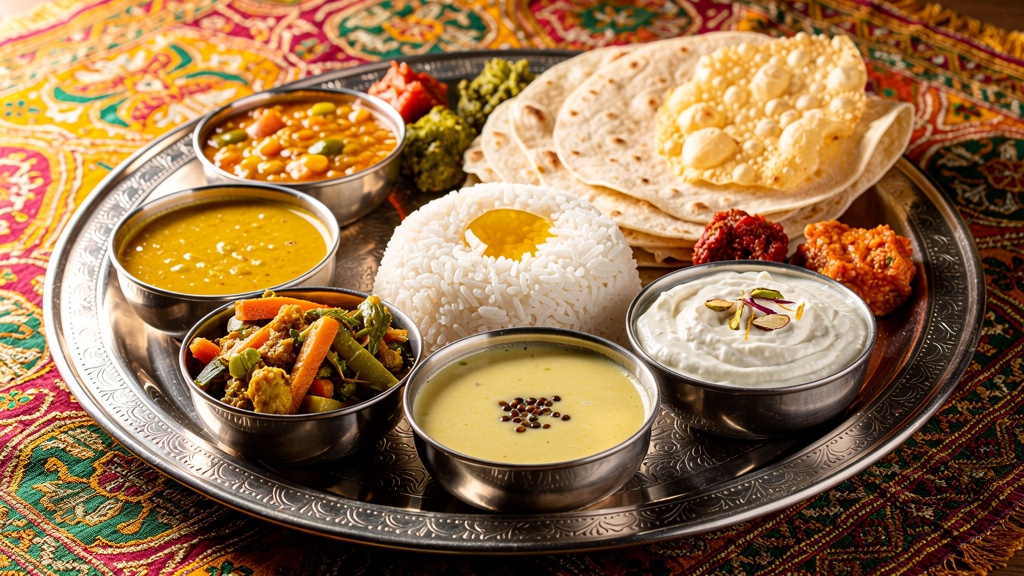
A lavish traditional Gujarati thali with multiple small bowls of vegetarian dishes
Local Cuisine

The Gujarati Thali — A Complete Universe on a Plate

If there is one experience in Mahesana that is absolutely non-negotiable, it is sitting down to a proper Gujarati thali at one of the city's traditional restaurants or local dhabas. This is not merely a meal — it is an institution, a philosophy, and a celebration of agricultural abundance and Jain-influenced vegetarian cooking that has been perfected over centuries.

A standard Gujarati thali might feature dal (lentil soup), kadhi (a thin yoghurt-based curry with gram flour), two or three sabzis (vegetable dishes), rotli (thin whole-wheat flatbread), bajra na rotla (thick millet flatbread), rice, khichdi, a variety of pickles and chutneys, papad, and two or three desserts — typically shrikhand (strained yoghurt with saffron and cardamom), gulab jamun, or basundi. The defining characteristic of the Gujarati thali is its harmonious balance of sweet, sour, spicy, and salty elements in every course, reflecting a culinary wisdom rooted in Ayurvedic principles of taste and nutrition.

In Mahesana, the dairy connection adds an extra dimension of richness: the milk, yoghurt, ghee, and buttermilk used in local cooking are famously fresh and high quality, sourced from the dairy co-operatives that have defined the region's economy for decades. Drinking a glass of Mahesana's chaas (salted buttermilk) on a hot afternoon is an experience that no amount of description can adequately convey — you simply have to be there.

Discover More Dishes

Where to Eat: Mahesana's Best Thali Restaurants

Look for restaurants serving "unlimited thali" on the main Mahesana-Unjha road. Local favourites include traditional Gujarati eateries near the bus station that serve fresh-cooked meals on steel plates from morning to night. The lunch service (12pm–3pm) is typically the most elaborate and best value.

Street Food You Cannot Miss

Mahesana's evening street food scene centres on Fafda-Jalebi (crispy chickpea fritters with sweet syrupy spirals), Khaman Dhokla (steamed chickpea cake), Gathiya (savoury fried chickpea sticks), and the ever-present Chai stalls serving cardamom-spiced tea that warms the soul on cool winter mornings.

Plan Your Trip

Essential Travel Information for Mahesana

Everything you need to know before you go — from the best season to visit to how to get around once you arrive.

Best Time

🌤️ October to March

The post-monsoon and winter months are by far the best time to visit Mahesana. Temperatures drop to a pleasant 15–28°C, the countryside is lush after the rains, and the major festivals — Navratri (Oct), Diwali (Oct/Nov), and Uttarayan (Jan) — are all celebrated during this window.

Full Seasonal Guide
Getting Here

✈️ Air, Rail & Road

The nearest major airport is Sardar Vallabhbhai Patel International Airport in Ahmedabad, approximately 75 km south. Mahesana Junction is a major railway station on the Western Railway line with direct trains from Mumbai, Ahmedabad, Delhi, and many other cities.

Transport Details
Accommodation

🏨 Where to Stay

Mahesana offers a range of accommodation options from budget guesthouses to comfortable mid-range hotels. For a more atmospheric stay, heritage havelis in surrounding villages offer an unforgettable taste of traditional Gujarati hospitality.

Find Places to Stay
Beyond the City

The Rural Heart of North Gujarat — Villages, Fields & Folk Traditions

Beyond Mahesana city's bustling commercial centre lies one of rural India's most rewarding landscapes — a tapestry of agricultural villages, ancient temples, seasonal rivers, and living craft traditions that offer a depth of experience few visitors to Gujarat ever discover. The district's villages have preserved ways of life that have changed remarkably little over centuries, even as mobile phones and motorcycles have integrated seamlessly into the rhythms of daily existence.

The village of Vadnagar, situated about 30 kilometres from Mahesana city, is a particularly rewarding destination for history enthusiasts. An ancient city with a history stretching back to the time of the Mahabharata (it is identified with the legendary city of Anandpur), Vadnagar retains two spectacular Kirti Toranas (freestanding ceremonial arches) from the Solanki period that are among the finest examples of decorative stone architecture in all of Gujarat. The Archaeological Museum at Vadnagar houses an impressive collection of objects excavated from the surrounding area, including coins, ceramics, and sculptures spanning over 2,500 years of continuous habitation.

The town of Unjha, approximately 20 kilometres north of Mahesana, is both a significant agricultural market and a major religious centre, famous for the Umiya Mata temple that draws pilgrims from across North Gujarat throughout the year. Unjha is also renowned across India as one of the country's most important spice and fennel (saunf) trading hubs — the aroma of fresh fennel pervading the market air on a cool winter morning is an unexpectedly magical sensory experience.

For those with a taste for spiritual tourism, the ancient town of Siddhpur — about 25 kilometres northwest of Mahesana — offers the haunting ruins of the Rudra Mahalaya, a once-magnificent Solanki-era temple complex that rivalled Modhera in scale and ambition before it was partially demolished during the medieval period. What remains — a row of imposing pillared halls and carved toranas amid later-period mosque structures — is both architecturally fascinating and historically profound, a testament to the complex layering of religious cultures that characterises the North Gujarat landscape.

Start Your Journey

Ready to Discover Mahesana?

Dive deeper into North Gujarat's greatest destination. Explore the temples, taste the food, dance the Garba, and create memories that will last a lifetime.

🏛️ See All Attractions 🎭 Culture & Food 🗺️ Travel Guide